Everything Envoyer does. Nothing to rent.
Built for Laravel, not limited to it — deploy steps are plain shell commands over SSH, so anything you can deploy from a GitHub repo works.
Zero-downtime releases
Each deploy builds a fresh release directory, then swaps the currentsymlink atomically. Requests never hit a half-deployed app.
Health-checked rollbacks
After activation, Conveyor polls a URL you choose. If it fails, the previous release is restored automatically.
Push to deploy
Webhooks for GitHub, GitLab, Gitea, and Forgejo — or a plain HTTP endpoint your CI can call after tests pass.
Multi-server, no agents
Deploy to any number of servers over SSH. Nothing to install or keep updated on the targets.
Encrypted env files
Edit .env files in the UI. Encrypted with AES-256-GCM at rest, gated by per-project access passwords, symlinked into every release.
Customizable pipeline
Builtin clone, activate, and purge steps plus a library of Laravel presets — composer, migrations, cache warming, queue restarts. Add, edit, and reorder freely.
Live deploy output
Watch every step stream in real time over WebSockets, per server.
No-deploy windows
Block deployments during peak hours with recurring weekly windows in each project's timezone. Rollbacks stay allowed.
One binary, one database
Go binary + SQLite. No Redis, no queue workers, no external services. Backs up with a single command.
Watch every deploy as it happens
Per-step, per-server output streams live to your browser — and every deployment keeps its full log for later.
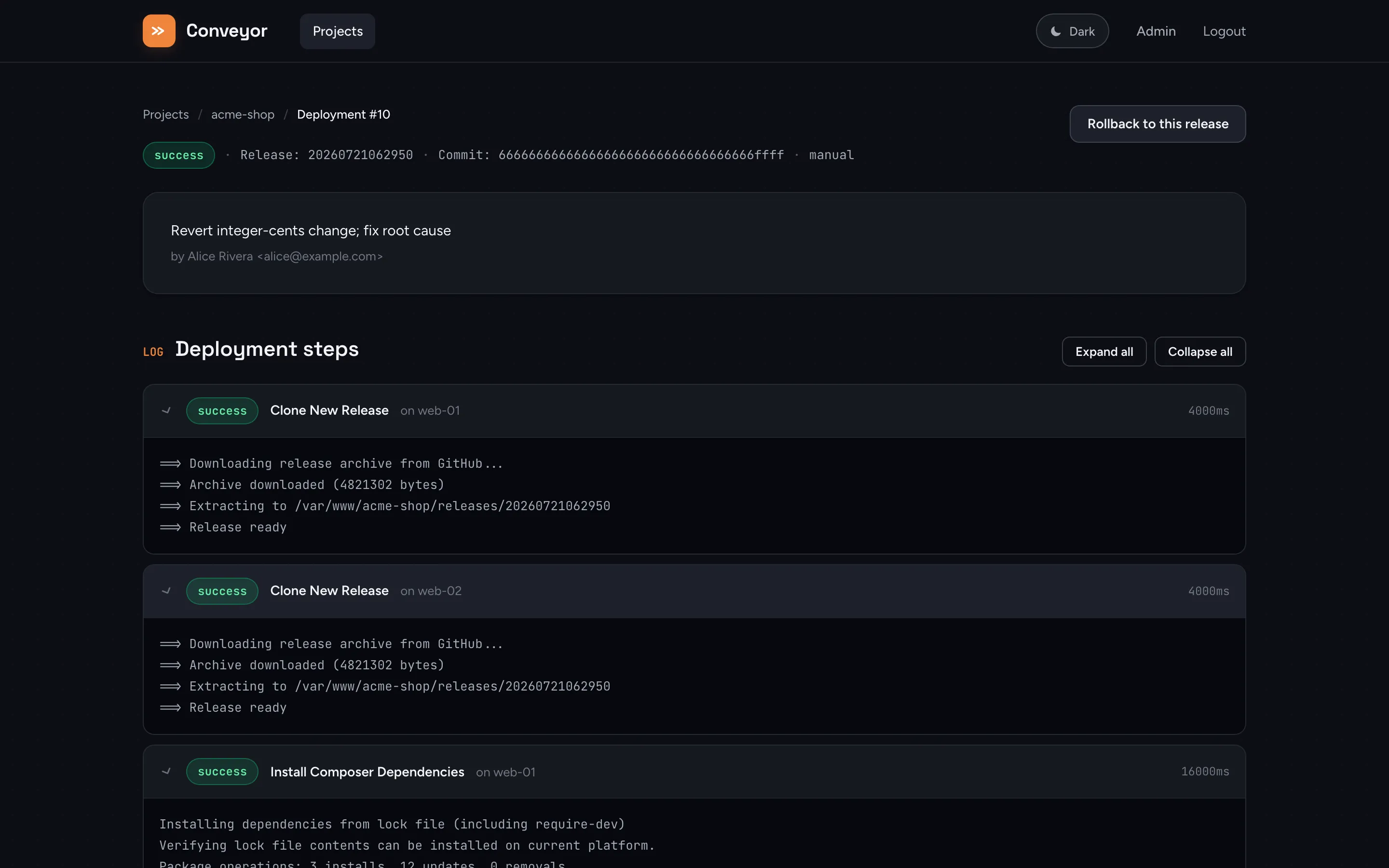
How a deployment works
- Download — Conveyor fetches a tarball of your branch. Only Conveyor needs a Git token.
- Upload — the archive is copied to each server over SCP.
- Extract — a new
releases/<timestamp>directory, with shared.envandstoragelinked in immediately. - Build — your steps run: composer install, migrations, cache warming, anything.
- Activate — the
currentsymlink swaps atomically; health check gates the result. - Purge — old releases beyond your retention limit are cleaned up.
Running in two minutes
# docker-compose.yml
services:
  conveyor:
    image: ghcr.io/smitmartijn/conveyor:latest
    ports: ["8080:8080"]
    volumes: [conveyor-data:/data]
    env_file: .env
volumes:
  conveyor-data:
$ docker run --rm ghcr.io/smitmartijn/conveyor:latest \
/app/conveyor-cli generate-key > .env.key
$ echo "CONVEYOR_ENCRYPTION_KEY=$(cat .env.key)" >> .env
$ docker compose up -dThen open http://localhost:8080. Theinstallation guide covers TLS, admin users, and upgrades.